Byzantine Castle “Kale” of Saint Panteleimon
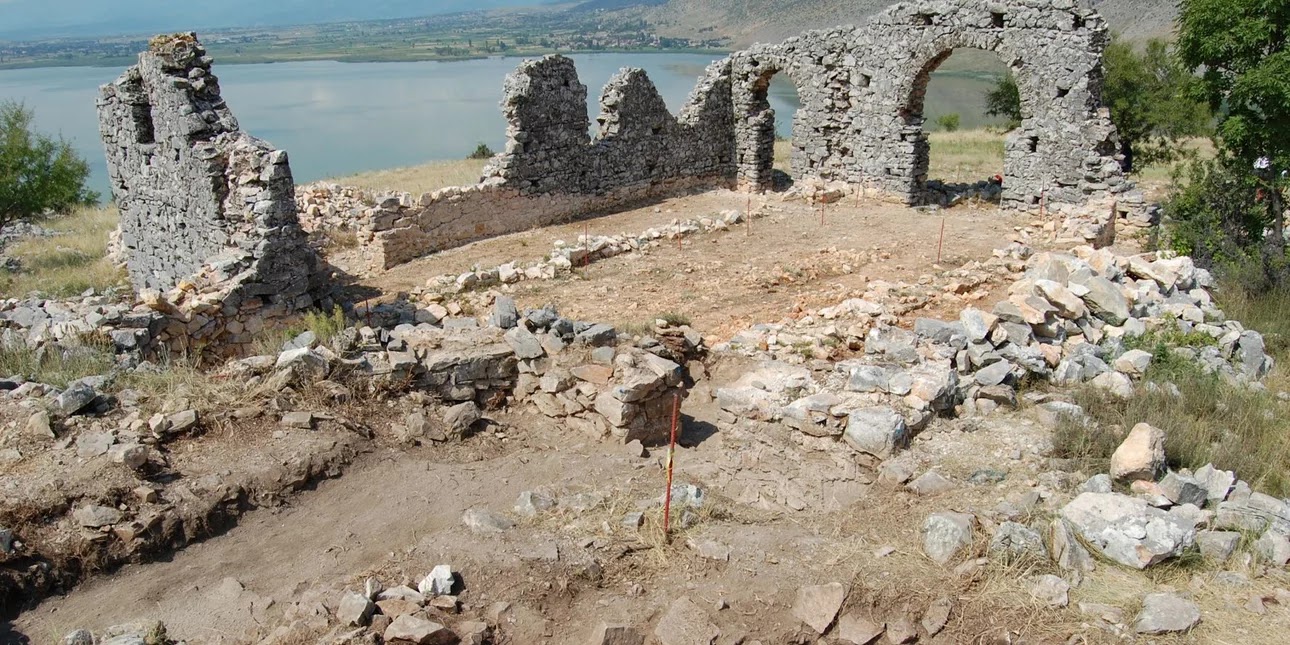
On the hill between Lakes Vegoritida and Petron, known locally as “Kale” (castle), the remains of an irregularly triangular fortification can still be seen. The existence of the castle ruins was first mentioned in 1913 in a publication by archaeologist Nikolaos Pappadakis, while a more extensive survey conducted “above the village of Petersko (now Petres)” was conducted in 1932 by Antonios Keramopoulos. From then on, and for many years, there was no progress in the investigation of the site until 2015, when the Aristotle University of Thessaloniki began collaborating with the Florina Ephorate of Antiquities on a systematic archaeological investigation of the site.
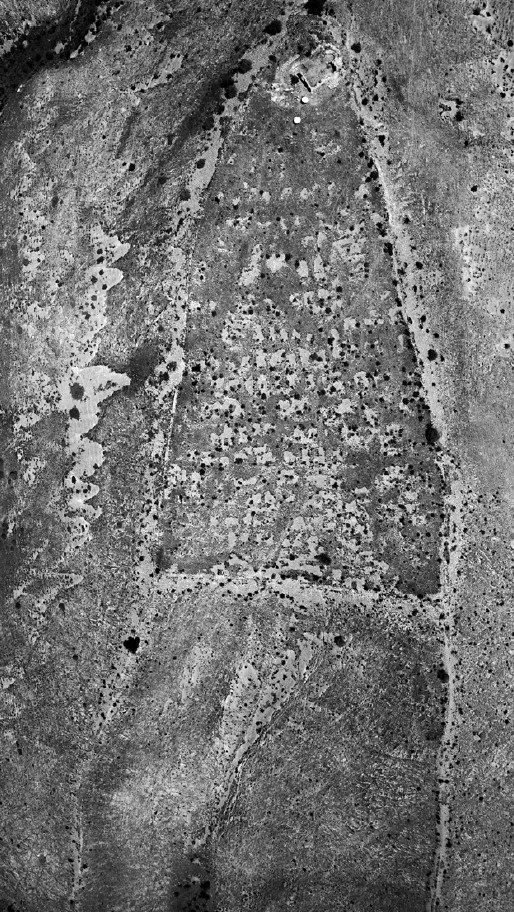
The castle is divided into two parts by a transverse wall, while the two perpendicular wings of the wall extend to the northern shore of Lake Petron, where the ruins of a watermill remain. The fortification has a total perimeter of 1,415 m and covers an area of approximately eight hectares, with the sturdy wall reaching a thickness of 1.70 m and a maximum surviving height of 2.60 m, built exclusively of stones bonded with strong lime mortar. The only possible entrance to the castle was located in the northeastern part of the acropolis, where a tall and massive elliptical pile of stones survives, which is likely to correspond to the ruins of a tower.
In the acropolis defined by the castle’s northern rampart, a total of 31 stone piles have been documented, corresponding to the ruins of rectangular houses with storage areas or small huts in an agro-pastoral settlement. Experts estimate that the houses in this densely built area likely sheltered families of five to six people, therefore the population in this section of the castle numbered approximately 200 people, with the possibility that the total population across the entire fortification was twice that number.
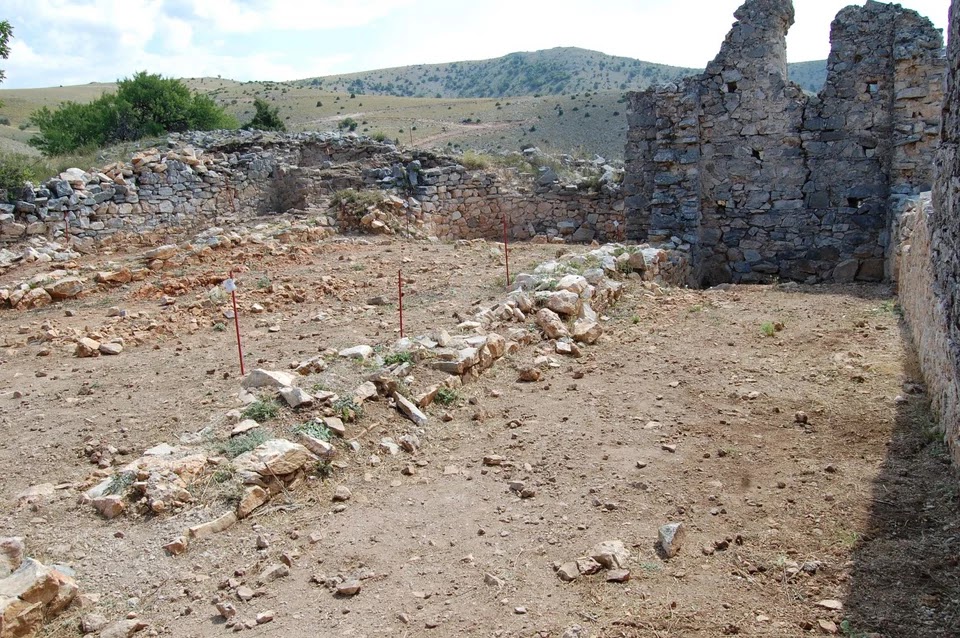
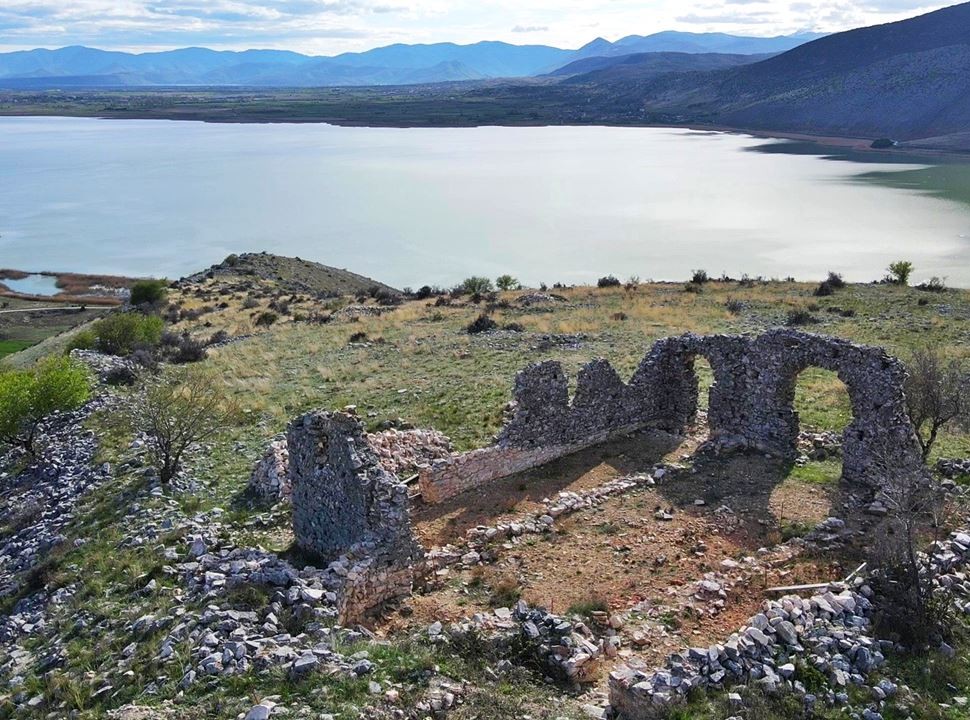
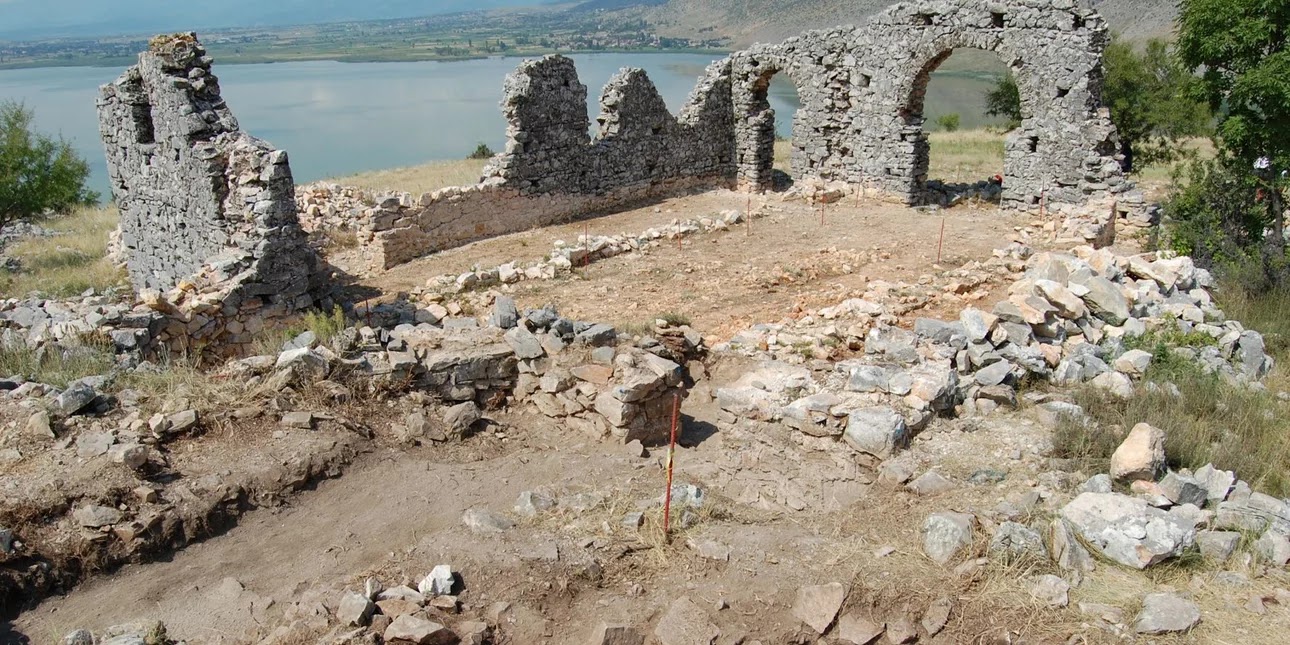
At the top of the hill, at an absolute elevation of 705 m, and on the plateau of the castle’s acropolis, the ruins of a church are preserved. During the site’s clearance work at the start of the modern archaeological investigation, the dimensions and form of the temple were systematically documented. It is an almost square, three-aisled basilica measuring 13.50 × 16 m, without a narthex and featuring a semicircular niche on the east side. The walls are up to 0.90 m thick, the maximum surviving height of the west wall is 4.75 m, while remnants of buttresses on the east and west walls indicate the points where the three aisles were divided, which would have been separated either by a row of pillars or by pillared walls. Each aisle terminates on the west side with a wide arched opening defined by an entrance gate of impressively robust construction.
The burials uncovered so far during excavations in a large part of the second aisle, as well as the intact infant’s grave in the eastern section of the diaconicon, indicate that the church also served as a mortuary chapel.
The church’s key architectural features—its square floor plan, the wide and unique semicircular apse of the sanctuary, and the buttresses on the east and west walls —are reminiscent of small basilicas from the 9th and 10th centuries and lead experts to date the church to this period or possibly slightly earlier, to the 8th century, with continued use during the Ottoman period.
The settlement and the castle were of strategic importance for the era and the region, as they overlooked the main passage of the Via Egnatia, Lakes Vegoritis and Petron, and the plains of Eordaia and, in part, of Lygistis. The castle is most likely identified with the place name “Peteriskos”, as mentioned by Ioannis Skylitzis and Kekavmenos, historians of the 11th century. In fact, according to Skylitzis, Gabriel Radomir, son of Tsar Samuel, was killed “in Peteriskos” in 1015, that is, shortly before the definitive dissolution of the Bulgarian state in Macedonia by Basil II and the reintegration of the region into the Byzantine Empire.
Based on the pottery that has been collected, it appears that life at the castle did not continue after the establishment of Ottoman rule in Macedonia in the 14th century, since the reasons for protecting the area and the Byzantine Empire’s defensive needs had ceased to exist. Most likely, the inhabitants moved to the area of the modern neighbouring settlement of Petres, which is referred to in an Ottoman register from 1481 as Petersko, a settlement that numbered 67 households—that is, taxable units—with an estimated population of 350–400 people.
Photos